

A young Harold with his dad, Charles. 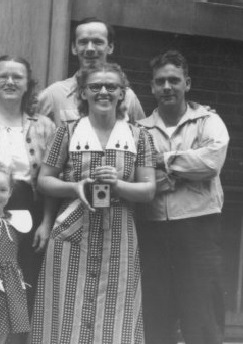
A family reunion in the 1950s: Harold with sister Flora, brother Charles Jr., and his first wife, Ruth (with camera). 
Harold Edgar Rosberg, circa 1960s.
Harold Edgar Rosberg was born in Chicago, Cook County, Illinois in June of 1920, the youngest child of Charles Benard Rosberg, Sr. and Lydia Lee.
Harold’s birth was a significant event for his parents: just 12 months earlier, in June of 1919, they had endured the sorrow of losing their infant son, Philip Raymond Rosberg. Harold’s birth was a renewal of joy and life in their family, and one gets the sense that he was appreciated by his parents and siblings alike as their darling boy.
Harold’s older sister, Flora Ann Rosberg, told many tales of the exploits and childhood adventures of the Rosberg children as they were growing up in Chicago in the 1920s. In those days, children were expected to amuse themselves and play outside for hours and hours, largely unsupervised by adults. They had many carefree hours of creative fun, and also many frightening incidents and even close shaves with death, such as falling through the ice on the Fox River, etc.
One tale in particular involved Harold: as the story goes, the children were playing around a warehouse or shop that had a conveyer belt which ran from an internal storage area, to an outdoor loading area. The conveyer belt was used for moving crates of milk bottles from one area to the other. Little Harold ended up sliding down this conveyer belt into the storage area and couldn’t get out again! He was stuck inside until his older siblings were able to raise the alarm and get help.
Another story Grandma told, had to do with milk mysteriously disappearing from the pantry, to the bewilderment of the entire family. Upon discovering yet another incident of milk pilfering one day, father Charles Rosberg called all the children together and demanded that the culprit own up to the deed.
“Now, one of you children has got to be the one swiping the milk!”
“It wasn’t me Dad, honest!”
“I haven’t even been in the pantry!”
“Well, I didn’t do it!”
“Me, neither!”
All four of the children earnestly protested their innocence, and the mystery went unsolved yet another day. But that night, after the children had gone to bed and Charles Sr. sat up for an evening smoke and a few moments’ quiet perusal of the newspaper, he thought he heard the pitter patter of little feet and went to investigate.
What did he see but his youngest son, Harold, on his feet fast asleep, and walking down the hall. Into the kitchen he walked and slumbered, with his father following him in astonishment. Into the pantry sleepwalked Harold, took a can of milk from the shelf, guzzled a healthy dose, put it back on the shelf, and shuffled back to bed without ever waking up at all. The Milk Bandit had been caught in the act! But under the circumstances, the only punishment he suffered for his deeds was the indignity of having the story of his somnambulistic thievery enshrined in family legend, to be retold and chuckled over for all time.
Harold’s family was not wealthy, but one advantage the Rosbergs had that many of their neighbors of the early 1920s did not, was access to private automobiles. This was due to Charles Rosberg, Sr.’s employment as an auto mechanic and chauffeur. The experience of growing up around cars literally had an impact upon Harold, and stayed with him all his days in the form of a very distinctive scar on his chin. It was related by his sister Flora that when Harold was a young child, he was a passenger in a car that was involved in a collision. As a result of the crash, Harold’s chin was very badly cut and laid open. Flora said that the subsequent scar was a disfigurement that although mild, was a source of some self-consciousness and insecurity for Harold as he was growing up.
As “marked” and “different” in feature or form as Harold may have felt at times, this paled in comparison to a life-defining event of far greater significance: in February of 1927, when Harold was just 6 years old, his mother passed away after a period of ill health. The emotional and economic consequences of this loss upon the Rosberg family were devastating and far-reaching.
Out of necessity, the Rosberg children were split up and “farmed out” to various carers or institutions: the eldest son, Charles Jr., remained with his father and they lived in a boarding house, Flora was sent to the former “Illinois Industrial School for Girls” in Park Ridge as a ward of the state, Mildred was taken in to live with Aunt Margaret Lee and her husband Charles Shaw in Ohio, and Harold too became a ward of the state, making his new home (along with over 150 other children) at the Methodist Deaconess Orphanage, in Lake County, Illinois.
After completing the 8th grade, Harold finished his formal education and pursued employment, which was not an uncommon thing for a 14-year-old youth of the 1930s. Energetic young men were wanted for posts in many industries, especially basic positions requiring manual labor, such as porters, delivery boys, dish washers, bus boys, errand boys etc. Harold was reunited with his father and his siblings in Chicago, all except for Millie, who remained with their aunt Margaret Lee in Salem, Ohio.
In October of 1941, with the dark clouds of war looming on the horizon, Harold enlisted in the U.S. Army. Two months later, the United States of America officially entered the conflict of WWII, and along with thousands of other men, Harold was assigned to military service in the Pacific.
After the end of the war, Harold returned home to Chicago, and married Ruth Martha Anderson, a longtime acquaintance of the family, and close friend of Harold’s sister, Flora. They made a very handsome couple, and although they did not have children of their own, they were much beloved by various nieces and nephews, and are still fondly remembered.
Harold worked as a postal carrier for many years.
Ruth died suddenly in 1967, leaving Harold a widower at the age of 47. He eventually married Margaret Joan Vivian Plantago, and the couple remained together until the time of his death in 1986.
-Auralie

 deadkeenfamilyhistory.news.blog